Close Menu
Peritoneo.life

    Subscribe to Our Newsletter

    Join our community of medical professionals and receive the latest expert insights, clinical updates, and breakthrough research on peritoneal surface malignancies.

    Latest Articles

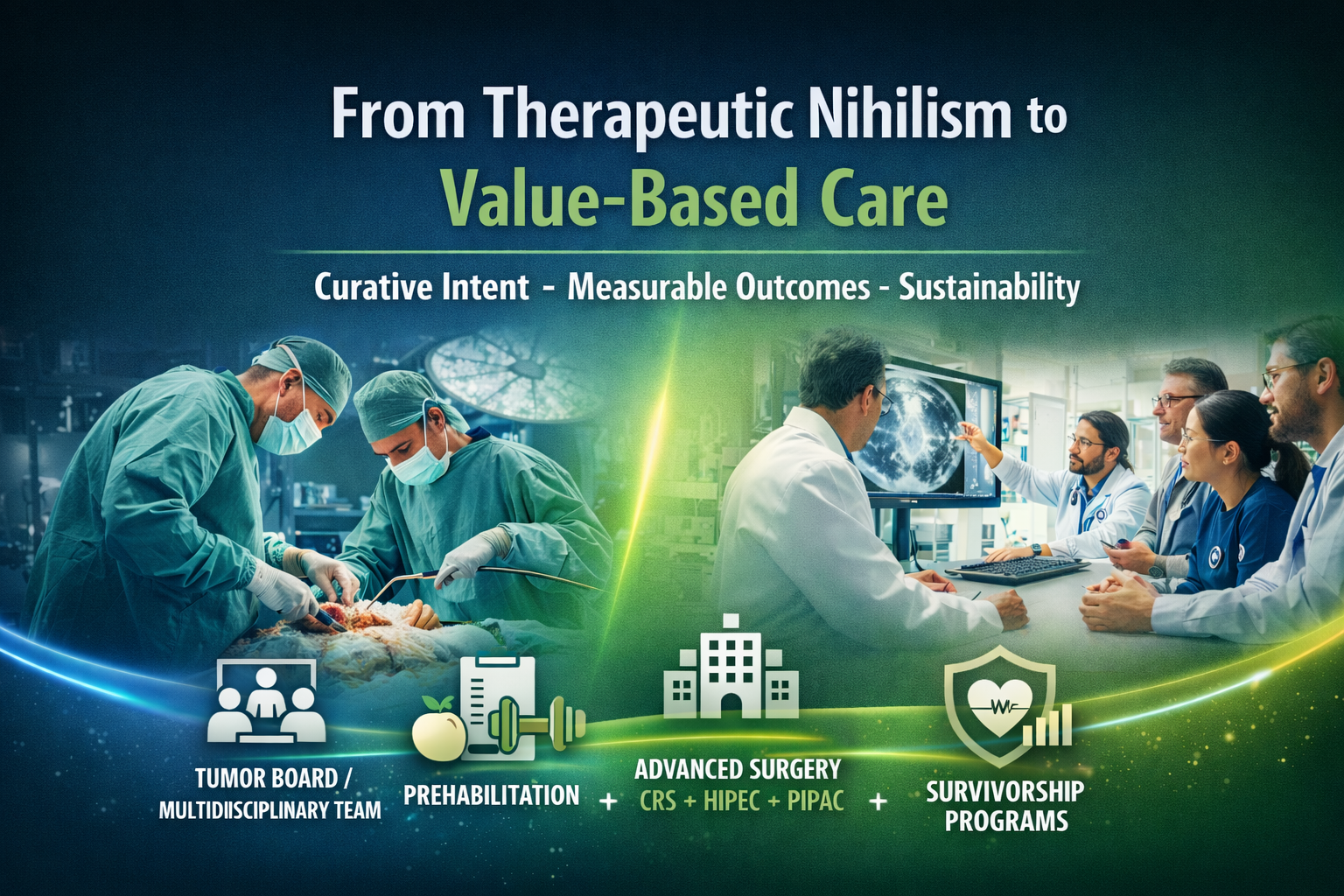
    From Therapeutic Nihilism to Value-Based Medicine

    02/06/2026

    🧬 Intestinal Transplantation for End-Stage Pseudomyxoma Peritonei: A Radical Frontier

    11/06/2025

    🧬 Exercise as a Treatment Strategy in Colon Cancer: Insights from the CHALLENGE Trial

    07/05/2025
    Instagram YouTube
    Peritoneo.lifePeritoneo.life
    Instagram YouTube
    NEWSLETTER
    • Home
    • Disease
      1. CCR PSM
      2. DMPM PSM
      3. GAST PSM
      4. LAPHIPEC
      5. OVA PSM
      6. PIPAC
NIPS
      7. PMP PSM
      8. Technique:
HIPEC
      9. View All

      🧬 Exercise as a Treatment Strategy in Colon Cancer: Insights from the CHALLENGE Trial

      07/05/2025

      Circulating Tumor DNA in Colorectal Cancer | ASCO GI 2025 Insights

      04/01/2025

      Revolutionizing Peritoneal Cancer Treatment: Key Studies Unveiled at ASCO 2023

      03/06/2025

      🔬 CHIPOR Trial: Does HIPEC Improve Survival in Recurrent Ovarian Cancer?

      04/06/2025

      🧬 Intestinal Transplantation for End-Stage Pseudomyxoma Peritonei: A Radical Frontier

      11/06/2025

      Understanding the GNAS Mutation in Pseudomyxoma Peritonei: Molecular Insights, Mucin Regulation, and Therapeutic Implications

      04/18/2025

      🔬 Immunotherapy in Pseudomyxoma Peritonei (PMP): Can We Overcome the Mucin Barrier?

      04/09/2025

      Understanding GNAS Mutations in Pseudomyxoma Peritonei: Molecular Insights and Clinical Implications

      04/09/2025

      🧬 Intestinal Transplantation for End-Stage Pseudomyxoma Peritonei: A Radical Frontier

      11/06/2025

      🧬 Exercise as a Treatment Strategy in Colon Cancer: Insights from the CHALLENGE Trial

      07/05/2025

      Understanding the GNAS Mutation in Pseudomyxoma Peritonei: Molecular Insights, Mucin Regulation, and Therapeutic Implications

      04/18/2025

      🔬 Immunotherapy in Pseudomyxoma Peritonei (PMP): Can We Overcome the Mucin Barrier?

      04/09/2025
    • Journal
      1. ASO
      2. EJSO
      3. JSO
      4. Pleura & Peritoneo
      5. View All
    • Spiral of Knowledge
      1. Basics of PSM
      2. Translational Research PSM
      3. View All
    • About Us
    • Contact Us
    Subscribe to Our Newsletter
    Peritoneo.life
    Home»Blog»From Therapeutic Nihilism to Value-Based Medicine
    Blog

    From Therapeutic Nihilism to Value-Based Medicine

    Dr. Artur ReisBy Dr. Artur Reis02/06/2026Updated:02/06/2026No Comments5 Mins Read
    Facebook LinkedIn WhatsApp Twitter Email
    Share
    LinkedIn Facebook WhatsApp Twitter Email

    The Care Pathway Revolution in Peritoneal Surface Oncology

    Introduction: When the paradigm truly shifts

    For decades, a diagnosis of Peritoneal Surface Malignancies (PSM) — traditionally labeled as peritoneal carcinomatosis — was synonymous with therapeutic futility. Treatment strategies were largely palliative, fragmented, and associated with limited survival benefit. Median overall survival rarely exceeded six months, accompanied by high symptom burden and inefficient resource utilization.

    Over the last two decades, this narrative has fundamentally changed.

    The development of Cytoreductive Surgery (CRS) combined with Hyperthermic Intraperitoneal Chemotherapy (HIPEC) and, more recently, Pressurized Intraperitoneal Aerosol Chemotherapy (PIPAC) has transformed peritoneal oncology into a highly specialized field with curative potential in selected patients.

    However, advanced technology alone does not guarantee meaningful outcomes.
    To translate innovation into real survival benefit, predictable outcomes, and financial sustainability, a new organizational model is required: an Integrated Care Pathway for Peritoneal Surface Malignancies.


    1. The hidden epidemiological and economic burden of peritoneal disease

    Peritoneal surface malignancies represent a heterogeneous group of diseases, including:

    • Primary tumors, such as Diffuse Malignant Peritoneal Mesothelioma and Primary Peritoneal Carcinoma
    • Secondary peritoneal metastases, most commonly arising from:
      • Ovarian cancer (60–70%)
      • Gastric cancer (15–43%)
      • Colorectal cancer (4–15%)

    Based on national cancer incidence data, a healthcare provider covering 100,000 insured lives can expect approximately 10–11 new high-complexity peritoneal oncology cases per year.

    The true challenge, however, lies not in incidence alone, but in how these patients navigate the healthcare system when no structured care pathway exists.

    Without coordination, patients frequently experience:

    • repeated hospital admissions,
    • acute bowel obstruction,
    • ICU utilization,
    • emergency surgical procedures with limited oncologic benefit.

    This leads to what can be defined as “blind claims burden” — high costs without strategy, measurable outcomes, or long-term value.


    2. Centralization, expertise, and patient selection: where prognosis is truly defined

    Robust evidence demonstrates that the most critical prognostic factor in peritoneal surface malignancies is the achievement of Complete Cytoreduction (CC-0).

    High-volume centers with dedicated multidisciplinary teams consistently achieve CC-0 rates between 92% and 97%, translating into significantly improved survival compared to low-volume institutions.

    An integrated care pathway ensures that:

    • every patient is evaluated within a multidisciplinary Tumor Board,
    • surgical candidacy is defined using Peritoneal Cancer Index (PCI), tumor biology, and treatment intent,
    • staging laparoscopy is systematically employed when appropriate.

    This structured approach avoids futile laparotomies, which may occur in up to 38% of cases when patients are not adequately selected, protecting both patients and healthcare systems from unnecessary harm and cost.


    3. Prehabilitation: the cornerstone of high-complexity risk management

    CRS and HIPEC are among the most demanding procedures in surgical oncology, with average operative times of 8 to 10 hours. In this setting, multimodal prehabilitation is no longer optional — it is a critical risk mitigation strategy.

    Comprehensive prehabilitation programs incorporating:

    • supervised physical exercise,
    • nutritional optimization,
    • psychological and medical support,

    have been shown to:

    • reduce direct hospital costs by an average of US$ 2,308 per patient,
    • shorten length of stay by approximately two days,
    • significantly decrease severe postoperative complications (Clavien–Dindo grade III–IV).

    Each avoided major complication represents a substantial economic and clinical benefit, often exceeding US$ 13,000 per event, while simultaneously improving patient experience and recovery.

    Prehabilitation transforms high-complexity surgery into a controlled, predictable, and value-driven process.


    4. Value-based medicine: when complexity and sustainability align

    When delivered within a structured care pathway, peritoneal surface oncology shifts from a cost-centered model to a value-based framework.

    Well-organized programs demonstrate:

    • positive institutional financial margins for CRS and HIPEC, particularly in open-account or referral-based models,
    • strong cost-effectiveness profiles, especially in ovarian cancer, where the addition of HIPEC during interval debulking surgery yields exceptionally low incremental cost-effectiveness ratios (ICERs), well below internationally accepted thresholds,
    • reduced litigation risk, improved patient satisfaction, and enhanced predictability of care delivery.

    Value-based healthcare does not mean spending less — it means investing strategically, guided by evidence, outcomes, and long-term impact.


    5. Survivorship and prevention: consolidating long-term return on investment

    The patient journey does not end at hospital discharge.

    Structured survivorship programs, particularly those centered on lifestyle medicine, have demonstrated profound oncologic impact. The CHALLENGE trial (NEJM, 2025) showed that a structured post-treatment exercise program reduced the relative risk of cancer recurrence or death by 28%, achieving over 90% overall survival at eight years.

    Looking ahead, integrated care pathways must expand toward primary and secondary prevention, including:

    • structured physical activity programs,
    • genetic risk assessment (e.g., BRCA mutations, Lynch syndrome),
    • early intervention strategies in high-risk populations.

    This evolution transforms healthcare organizations from passive payers into active stewards of long-term health outcomes.


    Conclusion: leadership, strategy, and the future of peritoneal oncology

    Implementing an Integrated Care Pathway for Peritoneal Surface Malignancies is not merely a clinical decision — it is a strategic leadership choice.

    By aligning:

    • certified technical expertise,
    • rigorous multidisciplinary selection,
    • structured prehabilitation,
    • longitudinal survivorship care,

    high-cost, high-risk cases can be transformed into units of measurable value, curative intent, and sustainable healthcare delivery.

    Peritoneal oncology has already evolved.
    Now, healthcare systems must evolve with it.

    Dr. Artur Chagas Vilela dos Reis
    Specialist in Peritoneal Surface Malignancies (ESPSO / ESSO)

    www.drarturreis.com.br

    Share. Facebook LinkedIn WhatsApp Twitter Email Telegram Copy Link
    Dr. Artur Reis
    • Website

    Dr. Artur Reis– Specialist in Peritoneal Surface Oncology, certified by the European Society of Surgical Oncology (ESSO). With expertise in Cytoreductive Surgery with HIPEC and PIPAC, Dr. Reis is committed to advancing surgical oncology through research, education, and innovation. As the curator of P.life Papers, he bridges the gap between clinical practice and scientific knowledge, ensuring that oncology professionals have access to cutting-edge research and best practices. He is the Director of the Specialized Center for Peritoneal Surface Oncology at Santa Casa de São José dos Campos and the Director of the Peritoneal Oncology Center at Hospital Rede D'Or Vivalle. Registered medical doctor with the Brazilian Medical Council (CRM-SP: 124.285/ RQE:41.487).

    Related Posts

    🧬 Intestinal Transplantation for End-Stage Pseudomyxoma Peritonei: A Radical Frontier

    By Dr. Artur Reis11/06/2025

    🧬 Exercise as a Treatment Strategy in Colon Cancer: Insights from the CHALLENGE Trial

    By Dr. Artur Reis07/05/2025

    🧠 P.life Papers – Science That Reaches Further

    By Dr. Artur Reis03/23/2025
    Leave A Reply Cancel Reply

    Don't Miss
    Blog

    🧬 Intestinal Transplantation for End-Stage Pseudomyxoma Peritonei: A Radical Frontier

    By Dr. Artur Reis11/06/20250

    Intestinal transplantation pseudomyxoma peritonei Yesterday, I had the honor of serving as both moderator and…

    🧬 Exercise as a Treatment Strategy in Colon Cancer: Insights from the CHALLENGE Trial

    07/05/2025

    🧠 P.life Papers – Science That Reaches Further

    03/23/2025

    Carcinomatose Peritoneal: A Quantidade De Doença Faz Diferença? Entenda O Que É O PCI?

    02/27/2025
    Follow us
    • Instagram
    • YouTube
    Latest Articles

    🧬 Intestinal Transplantation for End-Stage Pseudomyxoma Peritonei: A Radical Frontier

    11/06/2025

    🧬 Exercise as a Treatment Strategy in Colon Cancer: Insights from the CHALLENGE Trial

    07/05/2025

    Understanding the GNAS Mutation in Pseudomyxoma Peritonei: Molecular Insights, Mucin Regulation, and Therapeutic Implications

    04/18/2025

    🔬 Immunotherapy in Pseudomyxoma Peritonei (PMP): Can We Overcome the Mucin Barrier?

    04/09/2025

    Subscribe to Our Newsletter

    Join our community of medical professionals and receive the latest expert insights, clinical updates, and breakthrough research on peritoneal surface malignancies.

    About
    About

    Explore the latest advancements in Peritoneal Surface Malignancies (PSM). This curated collection of research papers offers valuable insights, clinical findings, and surgical techniques. Stay informed about cutting-edge developments in PSM treatment and management, designed for PSM experts and physicians with a keen interest in this specialized field.

    Email Us: contato@peritoneo.life

    Latest Articles

    From Therapeutic Nihilism to Value-Based Medicine

    02/06/2026

    🧬 Intestinal Transplantation for End-Stage Pseudomyxoma Peritonei: A Radical Frontier

    11/06/2025

    🧬 Exercise as a Treatment Strategy in Colon Cancer: Insights from the CHALLENGE Trial

    07/05/2025

    Subscribe to Our Newsletter

    Join our community of medical professionals and receive the latest expert insights, clinical updates, and breakthrough research on peritoneal surface malignancies.

    Instagram YouTube
    • Home
    • Disease
    • Journal
    • Spiral of Knowledge
    • About Us
    • Contact Us
    • Privacy Policy
    © 2026 Peritoneo Life. Developed by Native Web Agência de Marketing.

    Type above and press Enter to search. Press Esc to cancel.